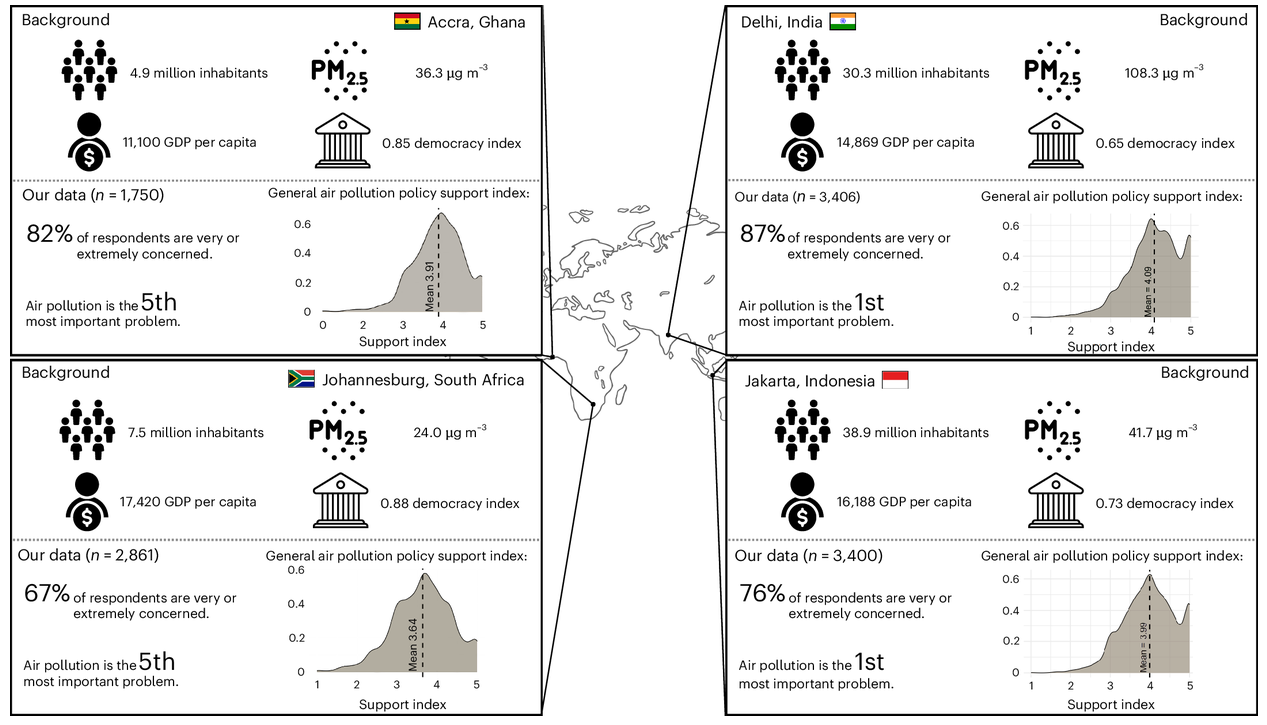
Our new paper is out in Nature Cities (link). Air pollution is a leading health risk in many emerging markets and developing economies, but it has been unclear whether residents actually demand mitigation, or whether they see poor air quality as a necessary price of development. We surveyed 11,417 adults in four severely polluted cities — Accra, Delhi, Jakarta and Johannesburg — and find that clean air is a top priority, with majorities backing six different mitigation policies, including cost-salient measures such as stricter industrial limits, expanded household electrification, and improved public transport. Concern, trust, and low behavioural control are the strongest predictors of support. People see air pollution, feel its effects, and want governments to act, even when action carries economic costs. The findings are also summarised in an accompanying policy brief in the same issue. This is from our SNIS-funded project on politically feasible clean-air policy, together with Ella Henninger, Camille Fournier de Lauriere, Vally Koubi, Raeesa Moolla, Liam Beiser-McGrath and Thomas Bernauer.